Occam's razor
(also written as Ockham's razor and in Latin lex parsimoniae) is a problem-solving principle devised by William of Ockham (c. 1287–1347). It states that among competing hypotheses, the one with the fewest assumptions should be selected. Other, more complicated solutions may ultimately prove correct, but—in the absence of certainty—the fewer assumptions that are made, the better.
The application of the principle can be used to shift the burden of proof in a discussion. However, Alan Baker, who suggests this in the online Stanford Encyclopedia of Philosophy, is careful to point out that his suggestion should not be taken generally, but only as it applies in a particular context, that is: philosophers who argue in opposition to metaphysical theories that involve allegedly “superfluous ontological apparatus”. Baker then notices that principles, including Occam’s Razor, are often expressed in a way that is not clear regarding which facet of “simplicity” — parsimony or elegance — is being referred to, and that in a hypothetical formulation the facets of simplicity may work in different directions: a simpler description may refer to a more complex hypothesis, and a more complex description may refer to a simpler hypothesis.
Solomonoff's theory of inductive inference is a mathematically formalized Occam's Razor:
Shorter computable theories have more weight when calculating the probability of the next observation, using all computable theories which perfectly describe previous observations.
In science, Occam's Razor is used as a heuristic (discovery tool) to guide scientists in the development of theoretical models rather than as an arbiter between published models. In the scientific method, Occam's Razor is not considered an irrefutable principle of logic or a scientific result; the preference for simplicity in the scientific method is based on the falsifiability criterion. For each accepted explanation of a phenomenon, there is always an infinite number of possible and more complex alternatives, because one can always burden failing explanations with ad hoc hypothesis to prevent them from being falsified; therefore, simpler theories are preferable to more complex ones because they are better testable and falsifiable.
realnewsaustralia.com
April 8, 2013
What exactly is the Hegelian Dialectic? Georg Wilhelm Friedrich Hegel was a 19th century German philosopher who devised a particular dialectic, or, method of argument for resolving disagreements. His method of arriving at the truth by the exchange of logical arguments is a system of thought process still use to this day.
To put it simply, the basis of Hegelianism dictates that the human mind can’t understand anything unless it can be split into two polar opposites. Good / Evil, Right / Wrong, Left / Right.
For example when people are talking about 2 political parties, Labor or Liberal, what they’re actually referring to, without realising it, is the thesis and the antithesis based off the Hegelian Dialectic. The only real debate that occurs is just the minor differences between those two parties. Nothing is said or done about the issues that neither left or right is discussing. This in particular will become more apparent as the election draws near
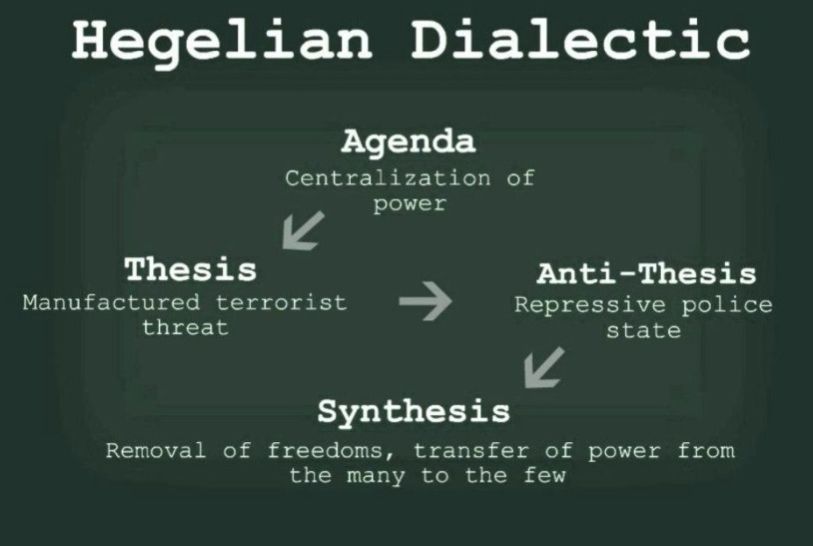
Another form of the Hegelian Dialectic is Problem – Reaction – Solution. Most of us unwittingly fall victim to it all too often and sadly if we don’t stop, we will continue to lose our free will and liberties. It has been widely used by our governments and corporations around the world. You could say that in terms of controlling the masses, and society in general, it’s deployment has been an effective tool in keeping humanity in check.
Almost all major events in history employ the Hegelian Dialectic of:
Problem – manufacture a crisis or take advantage of one already in place in order to get the desired Reaction of public outcry whereby the public demands a Solution which as been predetermined from the beginning.
A classic example is 9/11.
Only when you break the left/right paradigm and come to the realisation that the invasion of Iraq and Afghanistan and the whole fake, and not to mention contradictory, war on terror was the desired outcome for the neo-conservatives within the Bush administration and the whole military industrial complex. They in fact stated in their own white papers the need for another catastrophic and catalysing event like a “new Pearl Harbour”.
Here’s a more current example of the Hegelian Dialectic is use. In Australia at present both of the main political parties on the eve of the upcoming election on September 7 are discussing “Boat People”. A derogatory term used to describe refugees and asylum seekers displaced by war or other hardships. I don’t believe they constitute what you would call a “crisis” as the statistics clearly show they aren’t, but for the purpose of this example, our Government is telling us they are a problem. The media is used to play up this problem in order to instigate a reaction (debate) in the public domain on how to tackle it. Both the opposition and ruling party offer their solution.
Again we see that the only real debate occurring is just the minor differences between those two parties. Nothing is said or done about the many other more important issues that neither left or right is discussing.
In order to avoid falling victim to the Hegelian Dialectic from now on you must remember the process involved. Anytime a major problem or issue arises in society think about who will gain or profit from it. Then remove yourself from the equation and take a step back to look at it from a third party perspective. See the so-called “problem”, look at who is reacting, why and in what way. Then look for who is offering up the solution.
When you do this from now on you’ll quickly see the real truth instead of the false truth they wanted you to see
(also written as Ockham's razor and in Latin lex parsimoniae) is a problem-solving principle devised by William of Ockham (c. 1287–1347). It states that among competing hypotheses, the one with the fewest assumptions should be selected. Other, more complicated solutions may ultimately prove correct, but—in the absence of certainty—the fewer assumptions that are made, the better.
The application of the principle can be used to shift the burden of proof in a discussion. However, Alan Baker, who suggests this in the online Stanford Encyclopedia of Philosophy, is careful to point out that his suggestion should not be taken generally, but only as it applies in a particular context, that is: philosophers who argue in opposition to metaphysical theories that involve allegedly “superfluous ontological apparatus”. Baker then notices that principles, including Occam’s Razor, are often expressed in a way that is not clear regarding which facet of “simplicity” — parsimony or elegance — is being referred to, and that in a hypothetical formulation the facets of simplicity may work in different directions: a simpler description may refer to a more complex hypothesis, and a more complex description may refer to a simpler hypothesis.
Solomonoff's theory of inductive inference is a mathematically formalized Occam's Razor:
Shorter computable theories have more weight when calculating the probability of the next observation, using all computable theories which perfectly describe previous observations.
In science, Occam's Razor is used as a heuristic (discovery tool) to guide scientists in the development of theoretical models rather than as an arbiter between published models. In the scientific method, Occam's Razor is not considered an irrefutable principle of logic or a scientific result; the preference for simplicity in the scientific method is based on the falsifiability criterion. For each accepted explanation of a phenomenon, there is always an infinite number of possible and more complex alternatives, because one can always burden failing explanations with ad hoc hypothesis to prevent them from being falsified; therefore, simpler theories are preferable to more complex ones because they are better testable and falsifiable.
The Hegelian Dialectic and its use in Controlling Modern Society
April 8, 2013
What exactly is the Hegelian Dialectic? Georg Wilhelm Friedrich Hegel was a 19th century German philosopher who devised a particular dialectic, or, method of argument for resolving disagreements. His method of arriving at the truth by the exchange of logical arguments is a system of thought process still use to this day.
To put it simply, the basis of Hegelianism dictates that the human mind can’t understand anything unless it can be split into two polar opposites. Good / Evil, Right / Wrong, Left / Right.
For example when people are talking about 2 political parties, Labor or Liberal, what they’re actually referring to, without realising it, is the thesis and the antithesis based off the Hegelian Dialectic. The only real debate that occurs is just the minor differences between those two parties. Nothing is said or done about the issues that neither left or right is discussing. This in particular will become more apparent as the election draws near
Another form of the Hegelian Dialectic is Problem – Reaction – Solution. Most of us unwittingly fall victim to it all too often and sadly if we don’t stop, we will continue to lose our free will and liberties. It has been widely used by our governments and corporations around the world. You could say that in terms of controlling the masses, and society in general, it’s deployment has been an effective tool in keeping humanity in check.
Almost all major events in history employ the Hegelian Dialectic of:
Problem – manufacture a crisis or take advantage of one already in place in order to get the desired Reaction of public outcry whereby the public demands a Solution which as been predetermined from the beginning.
A classic example is 9/11.
Only when you break the left/right paradigm and come to the realisation that the invasion of Iraq and Afghanistan and the whole fake, and not to mention contradictory, war on terror was the desired outcome for the neo-conservatives within the Bush administration and the whole military industrial complex. They in fact stated in their own white papers the need for another catastrophic and catalysing event like a “new Pearl Harbour”.
Here’s a more current example of the Hegelian Dialectic is use. In Australia at present both of the main political parties on the eve of the upcoming election on September 7 are discussing “Boat People”. A derogatory term used to describe refugees and asylum seekers displaced by war or other hardships. I don’t believe they constitute what you would call a “crisis” as the statistics clearly show they aren’t, but for the purpose of this example, our Government is telling us they are a problem. The media is used to play up this problem in order to instigate a reaction (debate) in the public domain on how to tackle it. Both the opposition and ruling party offer their solution.
Again we see that the only real debate occurring is just the minor differences between those two parties. Nothing is said or done about the many other more important issues that neither left or right is discussing.
In order to avoid falling victim to the Hegelian Dialectic from now on you must remember the process involved. Anytime a major problem or issue arises in society think about who will gain or profit from it. Then remove yourself from the equation and take a step back to look at it from a third party perspective. See the so-called “problem”, look at who is reacting, why and in what way. Then look for who is offering up the solution.
When you do this from now on you’ll quickly see the real truth instead of the false truth they wanted you to see

No comments:
Post a Comment